At the moment we seem to be seeing gold doing a bit of a shuffle… but all will be good for gold as we go past this year says Newmont chief.
Australia looks likely to benefit from the higher gold prices on the back of a substantial recovery in production this year…. Thankfully P Costello won’t be in a position to bugger the industry again and Gordon brown is now little more than a joke so England won’t be selling their bullion at bargain. Our AUD might make things more interesting however and it is, for me at least, difficult to work out how a markedly stronger Australian dollar will affect individual compnaies and also the Gold ETFs.
Wealthy Chinese to fire up world gold price, says Richard O’Brien
Th World gold price has yet to peak and the steady emergence of a wealthy Chinese middle class will help underpin a move toward $US2000 per ounce over the next five years, said Richard O’Brien, chief executive officer of Newmont Mining yesterday.
Mr O’Brien said global gold demand and supply conditions are set to ensure the gold price remains robust over time, with entrenched weakness in the US dollar set to persist as Congress shows no sign of reining in the country’s budgetary woes.
“I’ve got to believe that the US dollar goes lower over time,” he said on the sidelines of the World Economic Forum on East Asia.
“I’m a firm believer that the gold price has not reached its peak, but it will remain volatile,” he added.
“Five years from now, $US2000 gold will probably be in reach,” Mr O’Brien said.
Next year, gold will trade in a narrow range of $US1500 to $US1600 per ounce, with the market focused on concerns about China’s ability to sustain its expansion, and the potential for a double-dip recession in the US economy, he added.
“That could be negative for gold,” but markets need to understand that whatever happens, the gold price will remain above $US1000 per ounce for the foreseeable future, he said.
“People need to get with the program,” he added.
Demand-side dynamics are set to remain strong while global gold supply tapers off in coming years as projects become more expensive to develop and government approvals are harder to get. Some central banks are also starting to buy gold again, he said.
Demand from both China and India for gold as both jewellery and as an investment is set to be strong, he said.
Comments Off on Gold to $2000 Newmont chief.
This story reinforces the perception of African sovereign risks. These sorts of issues have been very much on the minds of uranium investors that have a stake in companies with Namibian deposits….
Today’s Reuters article below shows that “Out of Africa” could be more than just a catchy film title… Where to go after Africa is for some investors reminiscent of the film Exodus. Personally I have returned nearly all of my holdings back to Australia… sure I might miss a lot of upside but I mighyt also miss the spears… unless I’m in NSW or WA coal seam gas or uranium almost anywhere in Australia after July….
(Reuters) – South Africa’s big three gold miners are upping their global presence as grades at home dwindle and regulatory uncertainty, nationalization talk and labor unrest raise domestic political risks.
The country also has the world’s deepest mines, making operations there increasingly costly and dangerous.
But the scramble out of South Africa is hardly risk free.
Following are some facts about their growing operations outside the country and some of the political risks they face.
GOLD FIELDS
Gold Fields, the world’s fourth-largest gold miner, is searching for El Dorado in Latin America.
It has invested heavily in Peru where production at its Cerro Corona mine is seen falling to between 330,000 and 360,000 ounces of gold equivalent in 2011, from 406,000 ounces in 2010.
Gold Fields is also exploring options in neighboring countries while moving ahead with Chucapaca, its $750 million Peruvian venture with Buenaventura. Its resources surpass 5.6 million ounces of gold equivalent and the target is to start production in 2015.
But the political risks in Peru are high.
Gold Fields has temporarily suspended its project in Hualgayoc, another joint venture with Buenaventura, due to social unrest in the area.
Sunday’s presidential run-off election in Peru pits a left-wing nationalist against a far rightest and both favor raising taxes on miners to fund social programs.
HARMONY
Harmony Gold, the world’s fifth-largest gold producer, is betting on its Papua New Guinea operations.
Its Wafi-Golpu project, which it shares with Australia’s Newcrest Mining Ltd, is seen as especially exciting though its estimates on production and costs remain very preliminary and wide.
It may yield 300,000 to 700,000 ounces of gold a year or 200,000 to 320,000 metric tones of copper. The costs have been pegged at $3 billion, but Harmony has said it could be closer to $4 billion of which it would be responsible for half. Papua New Guinea hardly offers a lower political risk environment than South Africa.
In Transparency International’s 2010 Corruption Perceptions Index, it ranks 154th out of 178 countries surveyed, tied with the likes of Russia and Kenya and below Libya and Iran.
Papua New Guinea is also high on the radar screens of global conservation groups and campaigners as it is seen as a “Lost World” of unique wildlife and biodiversity. So mining operations there are increasingly coming under environmental scrutiny.
ANGLOGOLD ASHANTI
Africa’s largest gold producer AngloGold Ashanti is boldly going where none of its peers had gone before.
It has operations in 11 countries and as of August, 2010, its non-South African operations accounted for 60 percent of its global output.
It is also exploring in some political hot spots, notably Egypt, Saudi Arabia and Eritrea.
AngloGold has significant operations in Mali, which is dealing with an Islamist insurgency and is becoming a magnet for drug trafficking.
But many of its operations are in politically stable countries such as Ghana, Namibia and the United States.
Comments Off on Out of the (African) Fat and into the Fire?
As described by the ABC News story below the decline was due to weather with the heavy rains impacting production and NOT due to a reprise of the Costello Curse.
Quarterly gold production falls
Australia’s gold production fell 7 per cent last quarter but is up about 6 per cent on the same time last year.
The Gold Production Report from Surbiton Associates reveals production for the three months to March 31, reached 65 tonnes, down five tonnes from the previous quarter.
The drop was largely due to cyclonic rains, stifling operations in both WA and the eastern states.
The managing director of the industry consultant group, Dr Sandra Close, says Kalgoorlie’s Super Pit was the largest producer for the quarter.
“It regained the top position again with 200,000 ounces, followed by Boddington at 166,000 ounces and Telfer was the third largest producer,” she said.
Comments Off on Australia's Gold Production starting to fall again
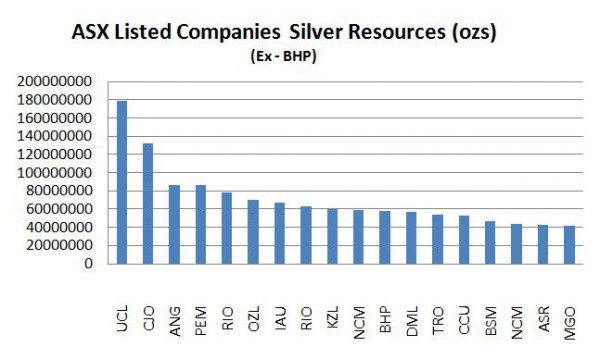
I hold several of the above. See discussion.
Comments Off on Mirror, Mirror on the wall who has the most SILVER of all?
China used to be a silver exporter based on its being one of the world’s top three silver producers….. now China has become the major importer of silver Of much interest to silver investors looking to the long term almost 70% of the silver imported by China is used in manufacturing.
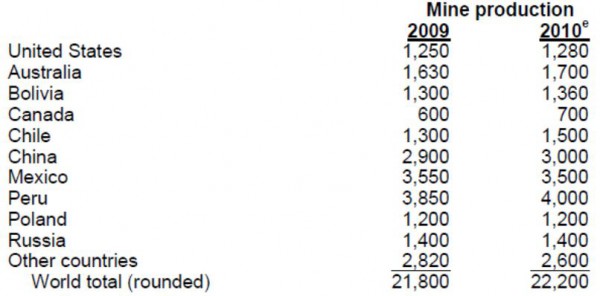
USGS 2011: As can be seen above Peru, Mexico and China were the top three producers…. Silver was obtained as a primary product from mines in Mexico, Peru, and Australia, in descending order of production.
Silver was also obtained as a byproduct from lead-zinc mines, copper mines, and gold mines, in descending order of production. The polymetallic ore deposits from which silver is recovered account for more than two-thirds of U.S. and world resources of silver. Most recent silver discoveries have been associated with gold occurrences; however, copper and lead-zinc occurrences that contain byproduct silver will continue to account for a significant share of future reserves and resources.
I think this bodes well for the long term silver investors as most silver is produced as a by-product of zinc/lead/gold mining and primary silver mines are relatively few as pure silver deposits aren’t abundant.
Even though Chinese silver mining witnesses significant growth and development in recent years, fueled by technological strides in exploration and an increase in production in response to steady growth in domestic and international demand China is a major global producer and consumer of silver-based brazing alloys. China has some of the world’s largest manufacturing facilities for home electronics and electrical appliances, which utilize various type of silver-based solder. China is the world’s largest producer of solar power and electronics.
Silver demand in China is soaring thanks to increasing use for industrial and jewelery purposes.
About 70% of China’s silver demand comes from the industrial sectors.
Silver is widely used in the China is the third largest producer of mined silver in the world.
China is the third largest producer of mined silver in the world.
China is top consumer of silver in the world.
Albanian_Minerals President Sahit_Muja said “Silver demand has witness a significant growth in 5 years, fueled by steady growth of silver use” http://www.pr-inside.com/china-s-net-imports-of-silver-hit-r2590259.htm Albanian_Minerals
Over the next few days I will have finished analysing Australia’s silver producers and will publish the data on www.australian-shares.com. My preliminary impression is that there are a couple of outstanding silver investments listed on our ASX.
Comments Off on China is now a net importer of silver.
Australian Gold Explorers have been updated to 1Q 2011.
Comments Off on Australian Gold Explorers – who has what
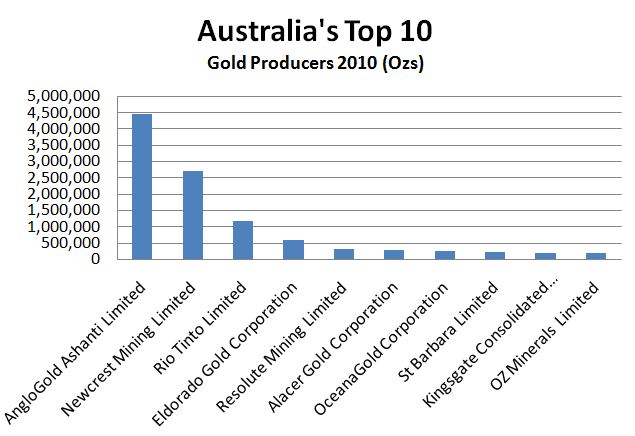
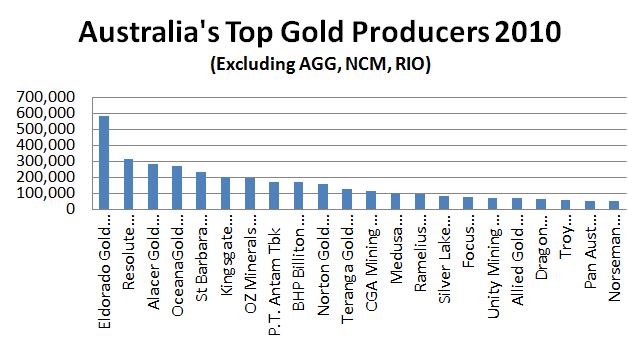
More information
Comments Off on Australian Gold producers at a glance
As was widely rumored IAU’s resource upgrade announcement was remarkable and has almost doubled the porphyry copper-gold resource at its Tujuh Bukit project to nearly 1 billion tonnes.
Granted the grades are very low…. but even then under usual circumstances such a large upgrade should have seen a far greater share market response…. makes me think that others share my concern re the forestry legislation… however some quite clever people are telling me that Indonesia wouldn’t take the chance of rattling market confidence by blocking this project.
Comments Off on IAU Resource Doubles
In an earlier post I was very positive about IAU however after reading through today’s announcement I’m less pleased…. the big worry for me is that the door seems to be wide open for the Indonesian Govt. to block the mining of the resource as the resource isn’t currently able to be open pit mined as it is in a designated “Forest area” where open pit mining is forbidden. As the resource is low grade (albeit most likely massive) the economics look dodgy for an underground mine….
But have a read of today’s announcement “MANAGEMENT’S DISCUSSION AND ANALYSIS” and tell me what you think.
Comments Off on Review of IAU
Last week I was asked about a company that had pegged some land near Mt Weld… I looked through the company’s reports and found that they were indeed right next door to Mt Weld’s ore body…. but have a read of the story excerpted below:
“THE story of the Great International Quartz Mining Company is remarkable, writes ANDREW MOLE
Outside Maldon, in the 1880s, the North British Mine produced 203,000 ounces of gold.
In today’s speak, that’s roughly $296 million.
Just a stone’s throw down the gully, within sight of each other, the Great International Quartz Mining Company extracted a miniscule 33 ounces.
But only after two years of back-breaking labour, hand-drilling more than 500 metres through nothing but solid rock.
In today’s speak that’s roughly $48,114.”
Comments Off on When NEAROLOGY doesn't work