
Andean Resources (ASX/TSX: AND) today announced further encouraging results from the ongoing drilling program at Cerro Negro. Today’s results include new high-grade discoveries at Mariana Norte and an update on the recently announced San Marcos discovery.
Mariana Norte is located about 2km southwest of the San Marcos veins and drilling has discovered at least 3 veins beneath the surface:
MRC 905: 4m of 10.9 g/t gold and 6 g/t silver from 80m
MRC-906: 7m of 18.5 g/t gold and 87 g/t silver from 186m and;
18m of 20.6 g/t gold and 33 g/t silver from 205m
MRC-909: 6m of 11.0 g/t gold and 90 g/t silver from 77m
MRC-911: 7m of 12.3 g/t gold and 142 g/t silver from 131m and;
6m of 41.8 g/t gold and 81 g/t silver from 141m and;
2m of 15.1 g/t gold and 30 g/t silver from 153m
I hold ANDEAN and have been greatly encouraged by the local commentary that suggests that AND will be one of the cheapest producers in the world with a production cost of around AUD$125 per oz.
Comments Off on Andean Gold strikes it rich yet againI recieved this in my in-box today. Most of it is a reiteration of what most “silver bugs” know and believe. (At least the ones I know). As it is a concise and pleasingly written piece of journalism I thought that I’d share it with you. As many of you know I hold a fairly large amount of silver in the form of long dated silver calls and bullion. And a smattering of silver miners… but these are pretty thin on the ground here in Australia.
HI HO SILVER!
Silver is often said to play “second fiddle” to gold, but history clearly points out during the secular bull markets for the precious metals, silver eventually catches up and outperforms gold dollar for dollar invested.
So far gold has already crossed its nominal high of $875 an ounce hit in 1980 during intra-day trading. But silver at $18.21 as I write this is nowhere near its nominal high hit in 1980 at $55.00 an ounce. This in my opinion is about to change in 2010. Silver has a lot of catching up to do and I think it’s time to highlight this so called ‘lesser metal”.
Silver is the Rodney Dangerfield of the precious metals complex; it gets very little respect and is often dubbed “Poor Man’s Gold”. But plenty of smart, rich guys have been interested in silver over the years including Warren Buffet, George Soros, and many others.
SILVER IS “MONEY” TOO
The investment community’s general neglect of silver has historical origins. For thousands of years, silver, not gold, was the coin of the civilized world. One of the most complete histories on silver can be found in the book “The Silver Bonanza” by Franklin Sanders and James Blanchard. The book begins with the following quote from Milton Friedman: “The major monetary metal in history is silver, not gold.”
Evidence of silver being used as money extends back to at least 4,500 years. According to “The Silver Bonanza”, the first mention of silver in the Bible is in the Old Testament in roughly 1850 BC. In King Charlemagne’s reign, silver was the only legal tender metal. Early colonial America preferred silver over gold and rigged the gold-silver ratio to encourage the flow of silver into the US. It took 15.5 to 16 ounces of silver to buy one ounce of gold in the rest of the world but, by decree, it took just 15 in early America.
Indeed, silver was the major monetary metal for the US until 1873 when it was demonetized and its richer cousin, gold, given the sole key to the currency kingdom.
Gold has received all the accolades and nearly all the ink ever since. Most “hard money” advocates will talk about gold as money for hours, as if it were religion. Lowly silver gets little or no time at all.
But don’t shy away from silver. Gold always moves first in a precious metals bull market, because it is seen more as money, yet silver posts better percentage returns nearly every time there is a sustained rally in gold. So why do people still ignore it, especially as it is priced so reasonably compared to gold right now?
There are five reasons that I see:
The 1873 demonetization of silver occurred roughly 100 years prior to the official end of the gold stan¬dard. Investors have short memories, so when they think of metal-backed currency they think of the modern era’s more recent experiences with gold, despite silver’s richer monetary history.
Silver is known as an industrial metal while gold and or gold stocks are considered an alternative to currency, an inflation hedge and a legitimate investment tool even by those not necessarily in the “hard money” camp. Yet silver functions often as a better inflation hedge ‘alternative currency” as well, but few investors believe it.
Even though there is far more silver on earth than gold, the silver market is much smaller than the gold market. This makes transactions much more visible and the market more susceptible to large fluctua¬tions. (Note there is approximately 17.5 times more silver than gold in the world which coincidently, is very close to the 16 to 1 monetary ratio of silver to gold that existed for thousands of years.
The discovery of the great Comstock Lode in 1859 caused the great decline in silver as a monetary metal. The supply of silver gushing out of Nevada simply overwhelmed its monetary usefulness with the result that silver became viewed as an unreliable standard for paper currency.
Lastly, as industrial economies of the world grew and photography was invented, a growing demand for silver began emerging for uses in these new areas. This industrial demand conflicted with silver’s mon¬etary demand, which also caused volatility to silver’s purchasing power.
While there is nothing to do about the tendency of investors to have short memories, there is a definite substitution effect between silver and gold. Silver may not be seen as a currency alternative right away but its monetary history eventually prevails and catches up and usually surpasses gold.
As problems with the dollar and other national currencies continue to worsen, some of the wealth flee¬ing national currencies will flow into silver, causing the ratio of the precious metals to decline as it has since the ratio was over 100 in the early 1990’s.
Eventually I see silver returning to its 16 to 1 ratio with gold before all is said and done with the secular bull market in the precious metals. What does that mean for how high silver could go?
Well, if gold is 1200 an ounce and you divide by 15 you would get $75 an ounce silver. If gold goes to make a true inflation adjusted new high, which would be roughly $6,500 an ounce, silver based on the 16 to 1 ratio would be $406.35 an ounce!
Right now the silver to gold ratio is 62 to 1 but with what I see happening in 2010 I think you will begin to see this ratio cut in half.
by Greg McCoach, Precious Metals Newsletter Writer, The Mining Speculator
Gold Investment Report
[email protected]
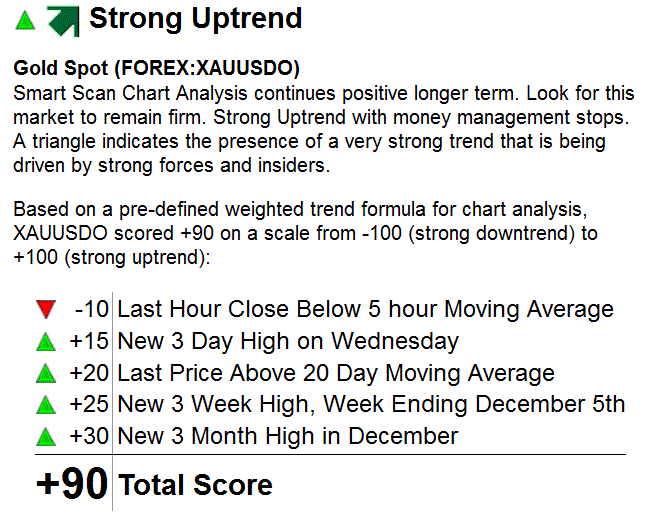
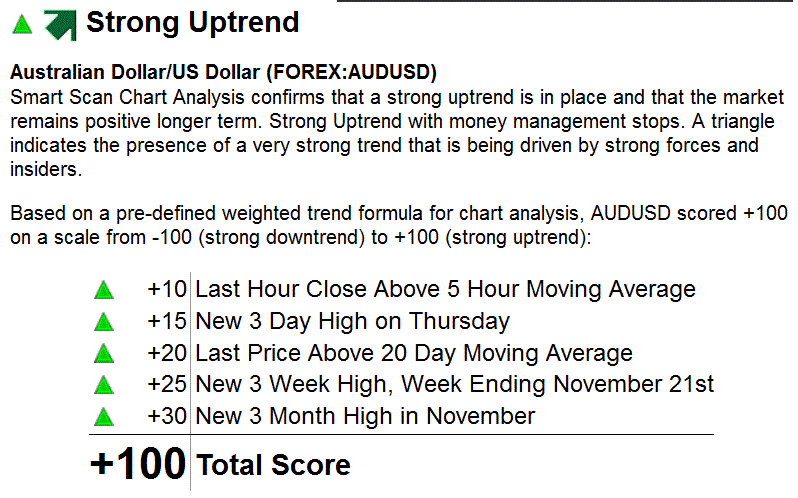
As most Gold investors know there has been relatively little action in the Gold price in terms of the AUD and our junior gold companies haven’t gained like their US counterparts.
The two images below are Marketclubs Trend analysis and it seems if they are right then this will not reverse in the near future. They are very bullish on gold but they are also very bullish on the AUD$ Vs the USD$ so if they are right then Aussie gold bugs have a bit more time to wait.
Gold rises and rises but is still far from 1980 peak
December 2, 2009 – 3:12PM
The gold price continues to surge but is yet to reach its all-time inflation-adjusted peak in 1980 that translates to more than $US2000 an ounce in today’s dollars, although it could reach this level if the US dollar continues to weaken.
The price of the precious metal eclipsed $US1200/oz ounce for the first time overnight as a battered greenback elevated demand for gold, a liquid asset class that is considered a hedge against inflation or political risk.
Spot gold in Sydney hit an unprecedented peak during Wednesday’s session of $US1208.90 and was recently trading at $US1207.40, up $US27.98 on Tuesday’s local closing price of $US1179.42.
US gold futures for February 2010 delivery on the New York Mercantile Exchange’s COMEX division struck a record $US1200.50/oz.
Gold’s previous peak was $US850 per fine ounce in February 1980, which translates into more than $US2000 when adjusted for inflation.
Sydney-based investment research company van Eyk says scope remains for a significant rally in the nominal gold price, but there could be considerable volatility in the near term.
Van Eyk chief executive Mark Thomas said on Wednesday that one particularly feverish commentator had predicted the gold price would hit $US5000/oz.
More pragmatic analysts say if the US dollar continues to weaken the gold price could rise to $US2000/oz – a proposition considered extremely bullish only a few years ago when global economic conditions were buoyant.
H3 Global Advisors portfolio manager Mat Kaleel said gold could easily go to $US3,000/oz “if conditions don’t return to normal and the US government keeps borrowing money’’, and amid expectations global gold supply would continue to decline.
Mr Kaleel and Mr Thomas pointed to US Federal Reserve governor Ben Bernanke’s recent quote ‘‘the Fed has a printing press and will use it to combat deflation if necessary’’.
‘‘They more money you issue, the price of gold relative to the amount of dollars should go up,’’ Mr Kaleel said.
‘‘They (the US) forecast a $US1 trillion ($1.1 trillion) deficit for the next 12 or six years on top of the $US12 trillion ($13 trillion) they already owe – that’s a 50 per cent increase in the money supply.
‘‘Over the next five to ten years, you could pick a figure for the gold price depending on how reckless you think the central banks are going to be – put it that way.’’
Mr Thomas said it would be prudent to hold gold as an insurance policy if the battle between the deflationary forces of the credit crunch versus the potentially highly inflationary monetary policies of most of the major economies continues.
‘‘Unless investors assume a return to fair weather with benign conditions in the global economy, and that the imbalances of the past decade have been resolved, van Eyk recommends continued exposure, notwithstanding the considerable volatility and currency-based fluctuations in the sector,’’ he said.
Among key drivers for the recent price spike has been the Reserve Bank of India’s (RBI) gold-buying spree.India’s central bank in the past month has bought 200 tonnes of the precious metal from the International Monetary Fund for more than $US6.7 billion.
‘‘It has been calculated that the RBI (Reserve Bank of India) has made $US800 million on the investment in just three weeks,’’ Mr Thomas said.
Mr Kaleel said the IMF was trying to sell another 200 tonnes, which could be snapped up by China and Russia.
AAP
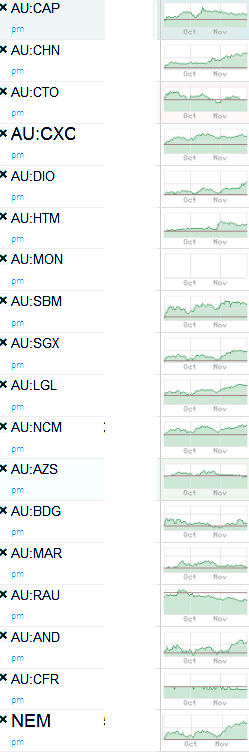
Comments Off on Will Gold get to its 1980 inflation adjusted peak?This is a sample of Australia’s gold companies… they are the ones on my own radar.
I hold AND, LGL, NCM, CHN and CXC… the ones with the bigger type face are dual listed. I believe that AND has the most upside and could be a ten bagger in the making.
ASX Code CDU – Cudeco is about to bring out a JORC following extreme pressure form their retail shareholders. To my mind this is causing them to release a JORC that is premature. They have so much more to drill and what they have drilled is very rich in Copper, Gold and Cobalt. It is said that CDU could commercially mine anyone of the credits, gold, copper or cobalt such is the richness of the deposit.
So here is a way to put the coming JORC in context of what is to come…..
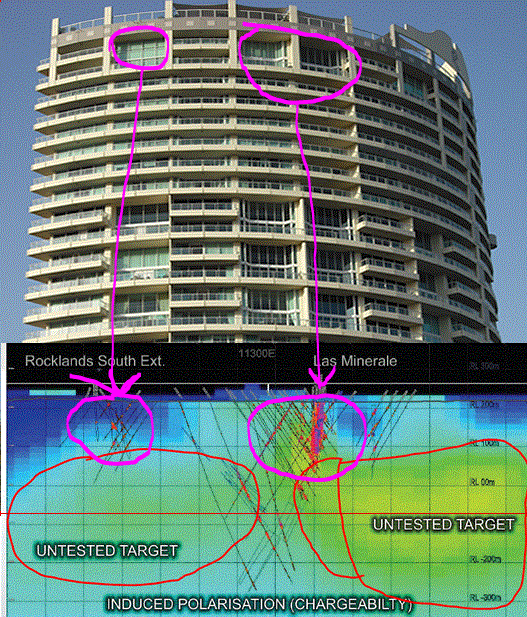
CDU JORC a gross undervaluation
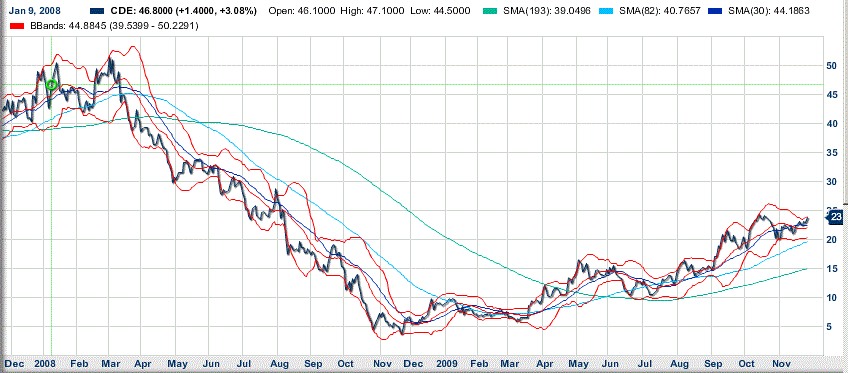
In addition to being a gold producer, Couer d’Alene is one of the world’s largest silver companies. CDE currently has mines in Bolivia, Mexico, Chile, Argentina and a surface mine in Nevada. In addition to owning mining operations, CDE also has non-operating interests in several mines.
New silver mines Bolivia and Mexico are expected to increase cash flow in the upcoming months. According to a recent research report from Knight Capital Group, CDE’s production of silver is expected to increase to 18 million ounces in 2009, up 50% from 2008. The opening of Kensington Gold Mine in 2010 is also expected to increase gold production.
Comments Off on Couer to increase silver production by 50% end of 2009For those that have been in CXC over the last 5 years it has been an unpleasant and costly experience. It now seems likely that CXC is starting to make gains.
Announcement:
Posts on this website are general "tips" and nothing more than that and should never be used to make an investment or trading decision. All information should be carefully cross-checked against official sources for accuracy.

 Lovely Hampton's Inspired Spacious
Southport Gold Coast Holiday House