Gold One International Ltd formerly BMA Gold, on the JSE in May 2009 and the subsequent acquisition by Gold One of all the issued ordinary shares in Aflease Gold Ltd by way of a scheme of arrangement.
The completion and commissioning of the company’s South African Modder East plant in late June 2009 was ahead of time and under budget.
A first gold pour from Modder East ore was achieved in late July 2009, one quarter ahead of schedule.
At the Ventersburg project in South Africa, the second phase of resource drilling started and a pre-feasibility study was initiated.
Gold One raised capital of $27 million by issuing 86.4 million shares from Australian and International institutions in August 2009.
Gold One 6,191 oz of gold (Au), from Modder East, nearby Sub Nigel and low grade commissioning ore during the September quarter.
As at the end of September 2009, Gold One had cash of about $30 million prior to the repurchase of bonds. Over $7 million of gold revenue had been received by Gold One in the September quarter and this revenue had been offset against the capital cost of the Modder East development.
At late October 2009, Gold One remained on track to produce its budgeted 20,000 oz Au for the 2009 ramp-up year. At htis time, the Modder East project was more than 95% complete and with the production of gold on a regular basis, the company had moved from being a developer to a producer.
For the December quarter of 2009, Gold One looked forward to declaring both continuous and commercial production at Modder East and also anticipated moving into monthly positive cash flow at the Modder East mine, with better than expected grade and wider than modelled channels.
A pre-feasibility study over the company’s Etendeka gold project in Namibia was due for completion in December 2009. In November the mine achieved a maiden operating profit, and commercial and continuous production were declared.
Forecasted gold production
16,000-20,000 oz of gold in 2009,
100,000-120,000 oz of gold in 2010
and 180,000 oz in 2011.
Mkt Cap `$230m
Cash ~$25m Zero debt
Caveats: Dependent on Gold price
Summary: The company has a history indicative of good management in that they bring their projects in on time. They are becoming a reasonably strong producer. No debt is a good thing. Cash costs well below $300 per oz and dropping. By 2011 earnings should be around 100m per annum.
Comments Off on Gold One ASX GDO a good cheap gold speccie
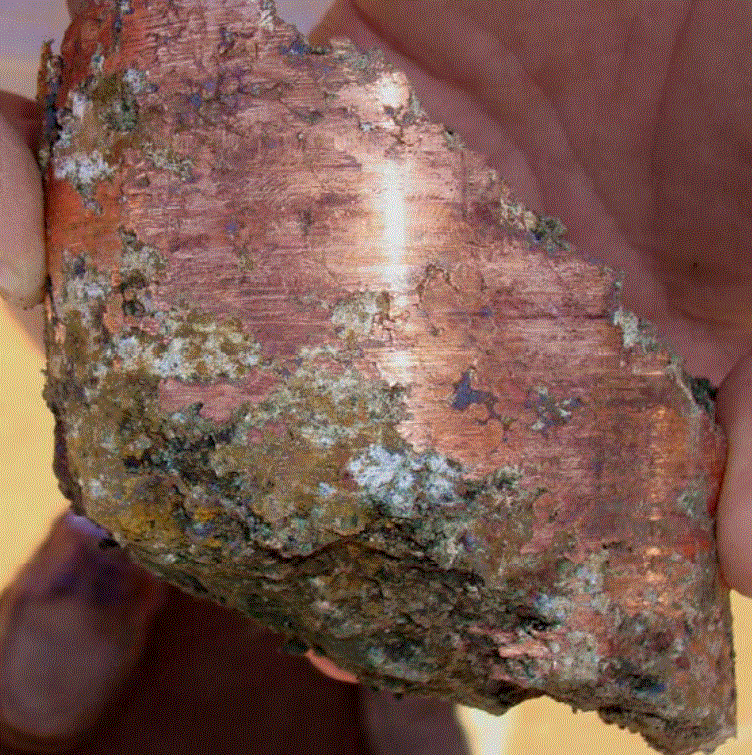
Wide diameter Metallurgical PQ Diamond Core Hole (85mm), designed to retrieve samples for grade modeling and metallurgical test work of the Las Minerale bonanza copper zones, intersected significant widths of high grade copper minerals including massive native copper in numerous zones from 20m-109m, and massive chalcocite in numerous zones from 20m-113m. The hole ended in primary mineralisation at 130.2m. Visible gold was also identified.
The result of all this hard work will be a unique copper project at Rocklands, with bonanza-grade supergene enriched native copper zones and a traditional primary copper zone, which internal studies indicate will result in an extremely robust operation. Further,Diamond core drill rig on 24 hour shift—deep drilling under Las Minerale due to Copper mineralisation commencing at or near surface, initial indications point to very low strip ratios, enhanced even further due to the existence of parallel offset zones of Cu/Co/Au mineralisation to the north and south of Las Minerale. Each of these offset zones, known as the Northern and Southern Siltstone Units, will essentially be accessed for free as part of the normal strip-back and waste removal process already required to access the main Las Minerale mineralisation.
Read report: http://www.cudeco.com.au/pdf/CDUQuarterlyDecember2009.pdf
Comments Off on CUDECO ASX CDU native copper and visible gold
Comments Off on Dr Copper looking a little anaemic?
LGL Joins Ranks of 1 Million Ounce Producers
PORT MORESBY, PAPUA NEW GUINEA–(Marketwire – Jan. 21, 2010) – Lihir Gold (TSX:LGG)(ASX:LGL)(NASDAQ:LIHR) –
Fourth Quarter 2009 – Group Overview
* Annual gold production exceeded 1 million ozs for the first time in the history of the company, rising 27% to a record 1.12 million ozs, in line with market guidance.
* Quarterly gold production of 278,000 ozs, up 19% compared to the September quarter.
* Record average realized cash gold price of $1,096/oz for the quarter and $956/oz for the year.
* Total cash costs at $397/oz for the full year, excluding Ballarat, in line with market guidance and positioning the company at the lower end of the global gold production cost curve. Quarterly total cash costs at $454/oz, reduced from $487/oz in the prior September quarter.
* Operating cash margins increased 42% to $460/oz for the year.
* Expansion projects proceeding to plan:
o Lihir Island Million Ounce Plant Upgrade proceeding on schedule and within budget.
o Bonikro expansion feasibility study due for completion by year-end.
Outlook
* Operating capacity now raised to more than 1 million oz/pa, rising to 1.3 million ozs in 2012 as expansion projects lift output at Lihir Island and at Bonikro.
* Group production in 2010 forecast to be between 960,000 – 1,060,000 ozs
* Total cash costs per ounce for 2010 to be below $450/oz, assuming stable oil prices and exchange rates. Costs for Lihir Island and Bonikro to be below $420/oz.
The Fourth Quarter Production Report is now available on the LGL website at www.LGLgold.com.
A live webcast and conference call for analysts will commence at 9.30am AEDT (Syd / Melb time). For dial in details please contact [email protected].
Comments Off on Lihir hits the 1 M oz per year production mark

Comments Off on Gold 1975 – 2010
Andean Resources (ASX/TSX: AND) today announced further encouraging results from the ongoing drilling program at Cerro Negro. Today’s results include new high-grade discoveries at Mariana Norte and an update on the recently announced San Marcos discovery.
Mariana Norte is located about 2km southwest of the San Marcos veins and drilling has discovered at least 3 veins beneath the surface:
MRC 905: 4m of 10.9 g/t gold and 6 g/t silver from 80m
MRC-906: 7m of 18.5 g/t gold and 87 g/t silver from 186m and;
18m of 20.6 g/t gold and 33 g/t silver from 205m
MRC-909: 6m of 11.0 g/t gold and 90 g/t silver from 77m
MRC-911: 7m of 12.3 g/t gold and 142 g/t silver from 131m and;
6m of 41.8 g/t gold and 81 g/t silver from 141m and;
2m of 15.1 g/t gold and 30 g/t silver from 153m
See the full release
I hold ANDEAN and have been greatly encouraged by the local commentary that suggests that AND will be one of the cheapest producers in the world with a production cost of around AUD$125 per oz.
Comments Off on Andean Gold strikes it rich yet again
I recieved this in my in-box today. Most of it is a reiteration of what most “silver bugs” know and believe. (At least the ones I know). As it is a concise and pleasingly written piece of journalism I thought that I’d share it with you. As many of you know I hold a fairly large amount of silver in the form of long dated silver calls and bullion. And a smattering of silver miners… but these are pretty thin on the ground here in Australia.
HI HO SILVER!
Silver is often said to play “second fiddle” to gold, but history clearly points out during the secular bull markets for the precious metals, silver eventually catches up and outperforms gold dollar for dollar invested.
So far gold has already crossed its nominal high of $875 an ounce hit in 1980 during intra-day trading. But silver at $18.21 as I write this is nowhere near its nominal high hit in 1980 at $55.00 an ounce. This in my opinion is about to change in 2010. Silver has a lot of catching up to do and I think it’s time to highlight this so called ‘lesser metal”.
Silver is the Rodney Dangerfield of the precious metals complex; it gets very little respect and is often dubbed “Poor Man’s Gold”. But plenty of smart, rich guys have been interested in silver over the years including Warren Buffet, George Soros, and many others.
SILVER IS “MONEY” TOO
The investment community’s general neglect of silver has historical origins. For thousands of years, silver, not gold, was the coin of the civilized world. One of the most complete histories on silver can be found in the book “The Silver Bonanza” by Franklin Sanders and James Blanchard. The book begins with the following quote from Milton Friedman: “The major monetary metal in history is silver, not gold.”
Evidence of silver being used as money extends back to at least 4,500 years. According to “The Silver Bonanza”, the first mention of silver in the Bible is in the Old Testament in roughly 1850 BC. In King Charlemagne’s reign, silver was the only legal tender metal. Early colonial America preferred silver over gold and rigged the gold-silver ratio to encourage the flow of silver into the US. It took 15.5 to 16 ounces of silver to buy one ounce of gold in the rest of the world but, by decree, it took just 15 in early America.
Indeed, silver was the major monetary metal for the US until 1873 when it was demonetized and its richer cousin, gold, given the sole key to the currency kingdom.
Gold has received all the accolades and nearly all the ink ever since. Most “hard money” advocates will talk about gold as money for hours, as if it were religion. Lowly silver gets little or no time at all.
But don’t shy away from silver. Gold always moves first in a precious metals bull market, because it is seen more as money, yet silver posts better percentage returns nearly every time there is a sustained rally in gold. So why do people still ignore it, especially as it is priced so reasonably compared to gold right now?
There are five reasons that I see:
The 1873 demonetization of silver occurred roughly 100 years prior to the official end of the gold stan¬dard. Investors have short memories, so when they think of metal-backed currency they think of the modern era’s more recent experiences with gold, despite silver’s richer monetary history.
Silver is known as an industrial metal while gold and or gold stocks are considered an alternative to currency, an inflation hedge and a legitimate investment tool even by those not necessarily in the “hard money” camp. Yet silver functions often as a better inflation hedge ‘alternative currency” as well, but few investors believe it.
Even though there is far more silver on earth than gold, the silver market is much smaller than the gold market. This makes transactions much more visible and the market more susceptible to large fluctua¬tions. (Note there is approximately 17.5 times more silver than gold in the world which coincidently, is very close to the 16 to 1 monetary ratio of silver to gold that existed for thousands of years.
The discovery of the great Comstock Lode in 1859 caused the great decline in silver as a monetary metal. The supply of silver gushing out of Nevada simply overwhelmed its monetary usefulness with the result that silver became viewed as an unreliable standard for paper currency.
Lastly, as industrial economies of the world grew and photography was invented, a growing demand for silver began emerging for uses in these new areas. This industrial demand conflicted with silver’s mon¬etary demand, which also caused volatility to silver’s purchasing power.
While there is nothing to do about the tendency of investors to have short memories, there is a definite substitution effect between silver and gold. Silver may not be seen as a currency alternative right away but its monetary history eventually prevails and catches up and usually surpasses gold.
As problems with the dollar and other national currencies continue to worsen, some of the wealth flee¬ing national currencies will flow into silver, causing the ratio of the precious metals to decline as it has since the ratio was over 100 in the early 1990’s.
Eventually I see silver returning to its 16 to 1 ratio with gold before all is said and done with the secular bull market in the precious metals. What does that mean for how high silver could go?
Well, if gold is 1200 an ounce and you divide by 15 you would get $75 an ounce silver. If gold goes to make a true inflation adjusted new high, which would be roughly $6,500 an ounce, silver based on the 16 to 1 ratio would be $406.35 an ounce!
Right now the silver to gold ratio is 62 to 1 but with what I see happening in 2010 I think you will begin to see this ratio cut in half.
by Greg McCoach, Precious Metals Newsletter Writer, The Mining Speculator
Gold Investment Report
[email protected]
Comments Off on Silver set to soar?

 Lovely Hampton's Inspired Spacious